
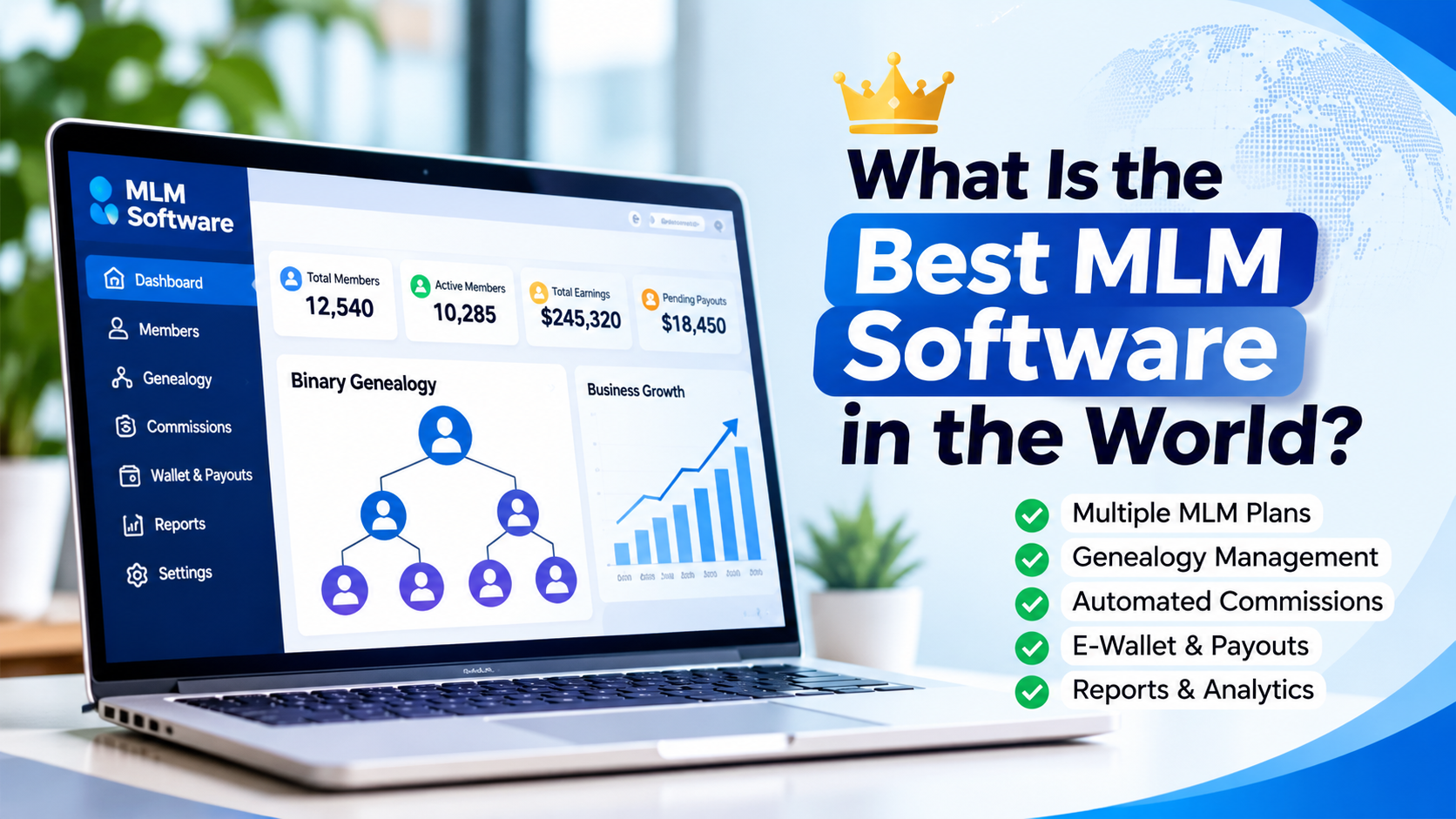
What is the best MLM software in the world?
Discover the essential features, compensation plans, automation tools, and technologies that make MLM software reliable, scalable, and suitable for modern network marketing businesses.
Introduction: Finding the Best MLM Software in the World
The network marketing industry has evolved dramatically over the past decade. What once depended heavily on manual calculations, spreadsheets, paperwork, and traditional communication has transformed into a technology-driven business ecosystem.
Today, thousands of direct-selling companies, network marketing organizations, affiliate businesses, and entrepreneurs operate across international markets. Their success increasingly depends on reliable technology, accurate commission calculations, transparent reporting, and efficient business management.
This brings us to one important question:
What is the best MLM software in the world?
Is it the software with the most advanced compensation plans? The platform with the fastest commission calculations? The system with the strongest security? Or the solution that can manage millions of members without compromising performance?
The truth is that there is no single MLM software that is automatically the best for every business.
The best MLM software is the one that understands your business model, accurately manages your compensation structure, protects your data, automates operations, and supports your long-term growth.
In this comprehensive guide, we will explore the essential features, technologies, compensation plans, security requirements, and business capabilities that distinguish world-class MLM software from ordinary network marketing applications.
Whether you are launching a new MLM company, expanding an existing network, or looking for a professional MLM software development partner, this guide will help you make an informed decision.
1. What Is MLM Software?
MLM software, also known as Multi-Level Marketing Software or Network Marketing Software, is a specialized business management platform designed to automate and manage the operations of a multi-level direct-selling organization.
It connects distributors, customers, sponsors, teams, commissions, products, payments, and business reports within a centralized digital environment.
Instead of managing thousands of members manually, companies can use MLM software to automate their business operations.
A professional MLM management system generally includes:
-
Member registration and account management.
-
Referral and sponsorship tracking.
-
Genealogy tree management.
-
Binary, Unilevel, Matrix, and other compensation plans.
-
Commission and bonus calculations.
-
E-wallet and financial management.
-
Product and order management.
-
Repurchase and renewal management.
-
Withdrawal and payout processing.
-
Admin dashboard and business reports.
-
Mobile-friendly distributor dashboards.
-
API and payment gateway integrations.
The primary purpose of MLM software is to reduce manual work, improve transparency, minimize calculation errors, and help businesses manage their growing networks.
2. What Makes the Best MLM Software in the World?
A world-class MLM software solution should not be judged by its appearance or the number of features listed on its website.
It should be evaluated based on its actual ability to solve complex business problems.
Here are the most important characteristics.
A. Flexible Compensation Plan Management
Every network marketing company operates differently.
Some businesses use binary structures, while others prefer Unilevel, Matrix, Generation, Board, or Hybrid compensation models.
The best MLM software should support the company's actual compensation rules instead of forcing the business to adapt to a limited system.
Important compensation plans include:
-
Binary MLM Plan
-
Unilevel MLM Plan
-
Matrix MLM Plan
-
Forced Matrix Plan
-
Generation MLM Plan
-
Board Plan
-
Australian Binary Plan
-
Spillover MLM Plan
-
Hybrid MLM Plan
-
Monoline MLM Plan
Advanced compensation engines should support configurable commission percentages, matching bonuses, rank achievements, capping rules, carry-forward calculations, and eligibility conditions.
Most importantly, every calculation should be transparent, testable, and auditable.
B. Accurate Commission Calculation
Commission calculation is the heart of any MLM system.
Even a small calculation error can create financial disputes, damage distributor confidence, and affect the reputation of a company.
A professional commission engine should accurately handle:
-
Direct referral commissions.
-
Binary matching bonuses.
-
Level commissions.
-
Pair commissions.
-
Sponsor bonuses.
-
Leadership bonuses.
-
Generation commissions.
-
Rank achievement rewards.
-
Repurchase commissions.
-
Performance incentives.
-
Daily, weekly, and monthly payouts.
A reliable system should maintain detailed transaction records and provide a clear explanation of how each commission was calculated.
C. Advanced Genealogy Management
Genealogy management is another essential feature.
A distributor should be able to understand their network structure without complicated manual calculations.
The system should provide:
-
Sponsor genealogy.
-
Placement genealogy.
-
Binary left and right positions.
-
Direct referrals.
-
Total downline members.
-
Active and inactive members.
-
Team business volume.
-
Level-wise member reports.
-
Member search and filtering.
-
Network growth statistics.
For large networks, genealogy queries and database structures must be carefully optimized.
A poorly designed genealogy system can become slow as the number of distributors increases.
D. Powerful Financial and E-Wallet Management
A professional MLM platform needs a transparent financial management system.
Different companies may require different wallet structures, such as:
-
Commission Wallet.
-
Deposit Wallet.
-
E-Wallet.
-
Shopping Wallet.
-
Repurchase Wallet.
-
Reward Wallet.
-
Withdrawal Wallet.
The system should support deposits, transfers, withdrawals, purchase deductions, refunds, and commission credits.
Every financial transaction should have a unique reference, transaction date, amount, transaction type, and appropriate audit information.
A proper ledger-based approach is essential for financial accuracy.
E. Payment Gateway and Payout Integration
International businesses need flexible payment infrastructure.
Depending on their operating countries, companies may require integrations with:
-
Stripe.
-
PayPal.
-
Razorpay.
-
PayU.
-
Bank transfer systems.
-
Supported local payment gateways.
-
Approved payout and disbursement APIs.
The software should also support payment verification, transaction reconciliation, webhook validation, failed payment handling, and refund management.
Payment gateway availability and legal requirements differ by country, so integrations must be selected according to the company's operating markets.
F. Complete Admin Control Panel
The administration panel should provide centralized control over the entire organization.
Administrators should be able to manage:
-
Members and registrations.
-
Products and categories.
-
Membership packages.
-
Compensation plan settings.
-
Commission processing.
-
Wallet transactions.
-
Withdrawal requests.
-
KYC verification.
-
Payment records.
-
Rank management.
-
Promotional banners.
-
Email and SMS notifications.
-
Reports and analytics.
-
System configuration.
A good admin dashboard should make complex operations understandable and manageable.
G. Mobile-Friendly Distributor Dashboard
Modern distributors expect to manage their business from smartphones.
A world-class MLM application should offer a responsive dashboard or dedicated mobile application.
Important mobile features include:
-
Personal business overview.
-
Referral link sharing.
-
Team member information.
-
Genealogy visualization.
-
Commission history.
-
Wallet balance.
-
Withdrawal requests.
-
Purchase history.
-
Rank progress.
-
Notifications.
-
Profile and KYC management.
A mobile-first experience can make the platform more accessible to distributors in different countries and regions.
3. Different MLM Compensation Plans Explained
Choosing the right compensation plan is one of the most important decisions when developing an MLM platform.
Let's understand the major structures.
Binary MLM Software
The Binary MLM Plan allows each distributor to build two primary teams, commonly called the Left Leg and Right Leg.
Commissions may depend on qualifying business volume, matching rules, weaker-leg calculations, and company-defined payout conditions.
Key features:
-
Two-leg genealogy.
-
Left and right placement.
-
Spillover management.
-
Pair matching calculations.
-
Carry-forward business volume.
-
Matching bonuses.
-
Daily or weekly payout processing.
Unilevel MLM Software
The Unilevel MLM Plan allows distributors to sponsor an unlimited number of direct members.
Commissions are calculated according to eligible levels and the company's compensation rules.
Key features:
-
Unlimited direct referrals.
-
Level-wise genealogy.
-
Multiple commission levels.
-
Direct sponsor bonuses.
-
Team performance reports.
Matrix MLM Software
Matrix MLM uses a predefined structure with fixed width and depth.
For example, a 3 × 5 matrix allows three direct positions per member across five levels.
Key features:
-
Fixed-width placement.
-
Defined matrix depth.
-
Spillover functionality.
-
Level-based rewards.
-
Matrix completion tracking.
Forced Matrix MLM Software
A Forced Matrix Plan places distributors within a predefined organizational structure.
It is useful for companies that need controlled placement and structured team expansion.
Generation MLM Software
Generation plans calculate commissions based on qualifying leadership generations and organizational performance.
The software must support generation identification, leadership qualification, and configurable generation payout rules.
Board Plan MLM Software
Board-based compensation structures involve predefined board positions, movement rules, completion conditions, and reward distributions.
The software should provide automated board movement and complete transaction history.
Hybrid MLM Software
Hybrid MLM combines two or more compensation models within a single platform.
For example, a business might combine Binary, Unilevel, and Generation commissions.
A properly designed hybrid compensation engine should prevent duplicate commissions and ensure that every payout follows clearly defined eligibility rules.
4. Essential Technical Features of World-Class MLM Software
Beyond compensation plans, the technical architecture determines how reliable and scalable the software will be.
Database Architecture
A professional MLM system needs an optimized database structure.
Important database components include:
-
User registration tables.
-
Sponsor and placement relationships.
-
Commission transaction tables.
-
Wallet ledger tables.
-
Order and invoice tables.
-
Product management tables.
-
Rank and achievement tables.
-
Withdrawal records.
-
Payment transaction tables.
-
Audit logs.
Database indexing, transaction handling, data consistency, and query optimization are particularly important for large genealogy networks.
Security and Data Protection
Security should never be treated as an optional feature.
A professional MLM application should implement:
-
Password hashing.
-
Secure authentication.
-
Role-based access control.
-
CSRF protection.
-
SQL injection prevention.
-
Input validation.
-
Secure session management.
-
API authentication.
-
Rate limiting.
-
Encrypted communication using HTTPS.
-
Financial transaction auditing.
-
Regular backups.
Companies operating internationally should also evaluate applicable data protection requirements, including GDPR where relevant.
API Integration
Modern MLM platforms should support secure API integrations.
Possible integrations include:
-
Payment gateways.
-
SMS providers.
-
Email services.
-
Mobile applications.
-
Accounting systems.
-
E-commerce platforms.
-
KYC verification services.
-
External reporting systems.
Well-documented APIs make it easier to extend the system in the future.
Scalability and Performance
A business with 100 distributors has very different technical requirements from a business with 500,000 distributors.
The architecture should be designed to accommodate expected growth.
Important considerations include:
-
Optimized database queries.
-
Efficient genealogy retrieval.
-
Background commission processing.
-
Caching.
-
Database indexing.
-
Queue-based processing.
-
Monitoring and error logging.
-
Backup and recovery strategies.
Scalability should be demonstrated through testing rather than promised through marketing statements.
5. Cloud-Based MLM Software vs Custom MLM Software
Businesses generally have two major choices.
Cloud-Based MLM Software
Cloud-based software is hosted and maintained by a provider.
Advantages:
-
Faster deployment.
-
Managed infrastructure.
-
Centralized updates.
-
Reduced server administration.
-
Subscription-based pricing options.
Possible limitations:
-
Limited customization.
-
Vendor dependency.
-
Recurring costs.
-
Restrictions on integrations.
-
Data portability considerations.
Custom MLM Software Development
Custom MLM software is developed around the company's business requirements.
Advantages:
-
Flexible compensation structures.
-
Custom admin dashboards.
-
Ownership and control of source code as agreed in the contract.
-
Custom integrations.
-
Flexible business workflows.
-
Greater control over future development.
Possible limitations:
-
Higher initial development investment.
-
Longer development time.
-
Maintenance responsibilities.
-
Need for ongoing technical support.
Which option is better?
A startup with a simple business model may prefer a ready-made platform.
An established organization with complex commission rules, multiple products, international operations, or unique business requirements may benefit more from custom MLM software development.
The decision should be based on budget, business complexity, technical requirements, and long-term ownership goals.
6. How to Choose the Right MLM Software Development Company
Selecting a software development partner is just as important as selecting the software itself.
Before making a decision, evaluate these factors:
-
Industry Experience: Does the development company understand network marketing business models?
-
Project Portfolio: Can it demonstrate completed and relevant MLM projects?
-
Compensation Knowledge: Can its developers explain Binary, Unilevel, Matrix, and Hybrid calculations?
-
Technical Expertise: Does the company understand database optimization, security, APIs, and scalability?
-
Customization: Can the system accommodate your actual business rules?
-
Testing: Does the company provide detailed commission testing and financial reconciliation?
-
Support: Is technical assistance available after deployment?
-
Documentation: Are database structures, APIs, and business rules properly documented?
-
Source Code Ownership: Are licensing, intellectual property, and source code rights clearly defined?
-
Legal Compliance: Can the software be configured to support applicable direct-selling, consumer protection, privacy, and financial regulations?
Never choose a development company based only on the lowest quotation.
The cheapest solution may become the most expensive if it produces inaccurate commissions, security vulnerabilities, or operational failures.
7. MLM Software and Legal Compliance: An Essential Consideration
Technology alone cannot make an MLM business legally compliant.
A responsible network marketing company must ensure that its compensation structure is based on legitimate business activities and complies with the laws of the countries where it operates.
A professional software platform should help enforce business rules such as:
-
Commission eligibility based on genuine qualifying transactions.
-
Transparent product and service records.
-
Accurate refund and cancellation handling.
-
Appropriate distributor verification.
-
Clear compensation disclosures.
-
Reliable financial records.
-
Proper consumer complaint management.
-
Applicable tax and reporting requirements.
Businesses should avoid compensation structures that reward recruitment alone or promise guaranteed income.
For example, in the United States, the Federal Trade Commission provides guidance on multi-level marketing and pyramid schemes.
Companies operating in India should also review the Consumer Protection (Direct Selling) Rules, 2021, and applicable amendments and requirements.
International businesses must evaluate the laws of every relevant jurisdiction with qualified legal professionals.
A well-developed MLM platform should support responsible business practices, not simply automate commission payments.
8. How Much Does Professional MLM Software Cost?
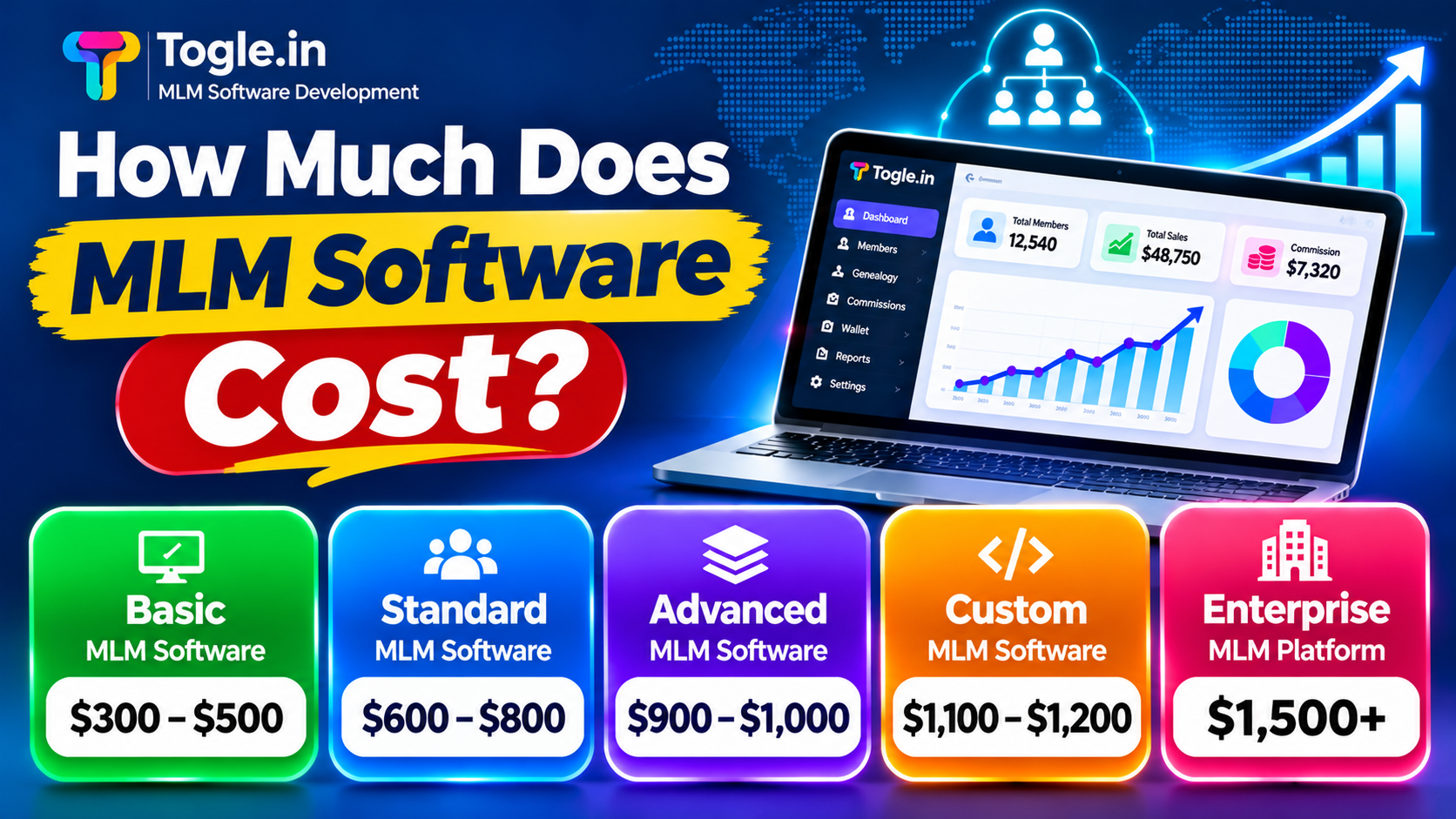
There is no universal price for MLM software.
The final investment depends on the number of compensation plans, business complexity, integrations, design requirements, security, and scalability.
A basic registration and referral application costs significantly less than a fully customized enterprise network marketing platform.
Factors affecting development cost include:
-
Number of compensation plans.
-
Complexity of commission calculations.
-
Number of admin and distributor modules.
-
Mobile application requirements.
-
E-commerce and inventory integration.
-
Payment gateway integration.
-
SMS and email automation.
-
KYC and verification systems.
-
Hosting and infrastructure.
-
Maintenance and support.
Instead of selecting software purely on price, businesses should evaluate the total cost of ownership and the reliability of the solution.
9. Why Customization Matters in Modern Network Marketing
Every network marketing company has its own operational requirements.
One company may need a Binary Plan with carry-forward volume and matching bonuses.
Another may require a Unilevel Plan with multiple generations, leadership bonuses, and monthly performance incentives.
A third may require a complete ecosystem combining e-commerce, product inventory, memberships, subscriptions, wallet management, and distributor commissions.
This is why customization matters.
A flexible MLM platform should allow businesses to define their compensation rules, automate their workflows, and integrate the tools they already use.
However, customization should never compromise calculation accuracy, financial transparency, or regulatory compliance.
10. The Future of MLM Software: AI, Automation and Advanced Analytics
The future of network marketing software will be shaped by automation, data intelligence, mobile technology, and improved user experiences.
Some emerging opportunities include:
Artificial Intelligence
AI-assisted systems may help businesses analyze sales trends, identify unusual transaction patterns, and generate operational reports.
Predictive Analytics
Business intelligence tools can help organizations understand product demand, customer retention, and distributor activity.
Automated Notifications
Smart notification systems can provide timely information about orders, payments, qualification progress, and business activities.
Advanced Reporting
Real-time dashboards can help management understand sales performance, business volume, product movement, and organizational growth.
Mobile-First Technology
Modern mobile applications will continue to make network marketing systems more accessible to distributors around the world.
The objective should always be to use technology to improve transparency, efficiency, and customer experience.
11. So, What Is the Best MLM Software in the World?
After understanding all these requirements, we can answer the original question.
The best MLM software in the world is not necessarily the platform with the biggest marketing campaign, the most expensive design, or the longest feature list.
It is the platform that consistently delivers:
-
Accurate commission calculations.
-
Flexible compensation plan management.
-
Reliable genealogy management.
-
Secure financial transactions.
-
Transparent reporting.
-
Scalable database architecture.
-
Powerful administration tools.
-
Mobile-friendly distributor experiences.
-
Flexible integrations.
-
Reliable technical support.
-
Responsible business rule enforcement.
There is no universally best platform for every company.
The right solution depends on the company's compensation model, products, markets, budget, regulatory requirements, and long-term business objectives.
Before selecting a provider, request a demonstration, review actual commission calculations, test real business scenarios, evaluate security, and understand the source code and support arrangements.
A good MLM software platform should not simply manage a network.
It should provide a reliable technological foundation for a sustainable and transparent business.
12. Togle Software: Building Technology for Network Marketing Businesses
At Togle Software, we believe that professional MLM software development requires much more than writing code.
It requires a deep understanding of compensation structures, genealogy management, business operations, financial calculations, and the technical challenges that arise as a network grows.
With more than 15 years of software development experience and over 350 completed projects, our focus is on developing practical, flexible, and business-oriented software solutions.
Our experience includes different types of network marketing systems and business applications.
Our development capabilities include:
-
Binary MLM Software.
-
Unilevel MLM Software.
-
Matrix MLM Software.
-
Forced Matrix MLM Software.
-
Generation MLM Software.
-
Board Plan MLM Software.
-
Spillover MLM Software.
-
Hybrid MLM Software.
-
E-commerce Integrated MLM Software.
-
Wallet and Payment Management Systems.
-
Custom Commission Calculation Engines.
-
MLM Admin and Distributor Dashboards.
We understand that every business has different requirements.
That is why we focus on custom development, flexible business logic, secure database architecture, and practical management tools.
Our goal is to help businesses build reliable digital systems that support their operations and future development.
We do not believe in one-size-fits-all software.
We believe in developing technology around real business requirements.
Explore our solutions: https://togle.in/
Discuss your MLM software requirements: https://togle.in/
Frequently Asked Questions (FAQ)
1. What is the best MLM software in the world?
The best MLM software is one that accurately handles compensation calculations, supports the company's business model, provides strong security, and scales with business growth. There is no single solution that is best for every organization.
2. Which company provides the best MLM software?
The right provider depends on your requirements, budget, compensation structure, technical expectations, and support needs. Compare actual demonstrations, project experience, and software capabilities before selecting a provider.
3. Which MLM software is best for a Binary Plan?
A good Binary MLM platform should provide two-leg genealogy, placement management, spillover, matching calculations, carry-forward business volume, and transparent commission reports.
4. Can MLM software support multiple compensation plans?
Yes. Custom MLM software can support multiple compensation models, including Binary, Unilevel, Matrix, Generation, Board, and Hybrid plans, depending on its architecture and business rules.
5. Is custom MLM software better than ready-made software?
Custom software offers more flexibility and control, while ready-made software can provide faster deployment. The right choice depends on the company's operational complexity and budget.
6. Can MLM software manage e-commerce and product sales?
Yes. An integrated system can manage products, categories, inventory, orders, invoices, payments, customer accounts, and eligible sales-related commissions.
7. Is MLM software suitable for international businesses?
Yes, provided the system is designed for the relevant markets. International requirements may include multiple currencies, languages, time zones, payment gateways, tax configurations, and data protection obligations.
8. How secure should MLM software be?
It should include secure authentication, password hashing, access controls, database security, CSRF protection, transaction auditing, encrypted communication, and regular backups.
9. Can MLM software calculate commissions automatically?
Yes. A properly configured commission engine can calculate eligible commissions according to predefined compensation rules, qualification requirements, and payout schedules.
10. How do I select an MLM software development company?
Evaluate industry experience, technical capabilities, completed projects, compensation plan knowledge, security practices, documentation, support, and source code ownership terms.
Final Thoughts
The future of network marketing depends on trust, transparency, responsible business practices, and reliable technology.
Choosing the right MLM software is not just a technical decision. It is a long-term business decision that can influence operational efficiency, distributor confidence, financial accuracy, and customer experience.
Take the time to understand your business requirements, compare solutions, test compensation calculations, and select a development partner that understands your goals.
The best MLM software is the one that helps your business operate accurately, grow responsibly, and build lasting trust.
Article published by Togle Software – MLM Software Development and Custom Business Solutions.
Like & Comments
Found this article helpful? Share your thoughts with us.

Leave a comment