
How can I start an MLM business?
A Step-by-Step Guide to Launching a Successful MLM Business
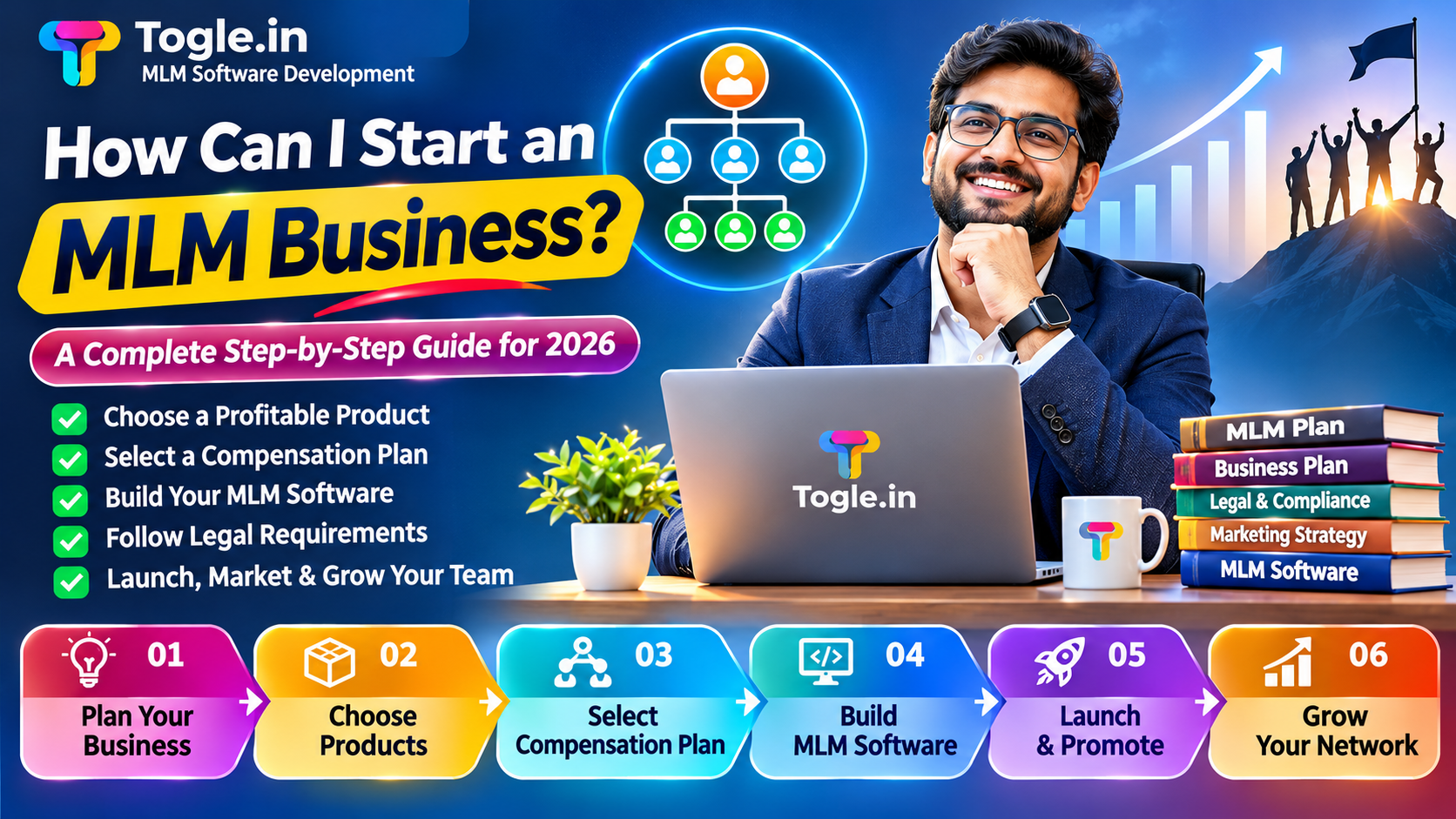
How Can I Start an MLM Business? A Complete Step-by-Step Guide for 2026
Starting a Multi-Level Marketing (MLM) business can be an opportunity for entrepreneurs who want to build a direct-selling company, develop a distributor network, and sell products or services through independent representatives. However, launching a successful MLM business requires much more than recruiting people. You need a valuable product, a sustainable business model, a transparent compensation plan, reliable MLM software, legal compliance, and a strong marketing strategy.
Whether you want to launch a small network marketing startup or establish an international MLM company, understanding the complete process can help you avoid expensive mistakes and build a business with long-term potential.
In this guide, we will explain how to start an MLM business from scratch, how to choose the right compensation plan, what features your MLM software should include, and how to grow your distributor network.
1. Understand How an MLM Business Works
Before starting an MLM company, you should understand the network marketing business model.
Multi-Level Marketing is a direct-selling model in which independent distributors promote and sell products or services. Distributors may also introduce new distributors to the business. Depending on the compensation structure, eligible participants can earn commissions from their own qualifying sales and the qualifying sales of their distribution network.
A typical MLM business includes:
-
Company: The organization that owns the products, services, brand, and business operations.
-
Products or services: The actual goods or services offered to customers.
-
Distributors: Independent participants who promote and sell the products.
-
Customers: People who purchase products or services.
-
Compensation plan: The documented rules for calculating commissions and other incentives.
-
MLM software: The technology used to manage members, sales, genealogy, commissions, wallets, and reports.
The most important principle is that your business should be built around genuine product or service value and real customer demand, not simply recruitment.
2. Choose the Right Products or Services
Product selection is one of the most important decisions when starting an MLM business.
A good product gives distributors a genuine reason to promote your company and gives customers a reason to purchase again.
Consider the following product categories:
Popular MLM product categories
Health and wellness
-
General wellness products
-
Personal care products
-
Fitness-related products
-
Health and lifestyle products
Beauty and personal care
-
Skincare products
-
Haircare products
-
Cosmetics
-
Personal grooming products
Home and lifestyle
-
Household products
-
Kitchen accessories
-
Cleaning products
-
Lifestyle accessories
Education and digital services
-
Online learning subscriptions
-
Professional training
-
Digital tools and services
-
Software subscriptions
How to select the right product
Before choosing a product, evaluate:
-
Market demand and customer interest.
-
Product quality and reliability.
-
Competitive pricing.
-
Profit margins and operating costs.
-
Repeat-purchase potential.
-
Supplier reliability and inventory availability.
-
Applicable product regulations and certifications.
Avoid selecting products only because they offer high commission margins. Your products must provide genuine value to customers.
3. Prepare a Complete MLM Business Plan
A professional business plan gives your company a clear direction and helps you understand the investment, operating costs, and growth opportunities.
Your MLM business plan should cover the following areas.
Business planning checklist
| Business area | What you need to plan |
|---|---|
| Business model | Direct selling and distributor structure |
| Products | Product categories, pricing and quality |
| Target market | Countries, regions and customer segments |
| Compensation plan | Commission rules and eligibility |
| Distributor policies | Registration, rights and responsibilities |
| Technology | MLM software and website |
| Marketing | Branding, advertising and promotion |
| Operations | Orders, inventory, delivery and support |
| Legal compliance | Company, product and direct-selling requirements |
| Financial planning | Investment, expenses and revenue projections |
You should also calculate your expected operating costs before launching. Include product sourcing, packaging, website development, software, payment processing, marketing, customer support, and administration.
A business plan should be financially realistic. Do not promise distributors guaranteed income or unrealistic returns.
4. Select the Right MLM Compensation Plan
The compensation plan determines how commissions and incentives are calculated. It is one of the most important parts of an MLM company.
Your compensation plan should be transparent, understandable, financially sustainable, and based on legitimate qualifying sales.
Here are some commonly used MLM compensation structures.
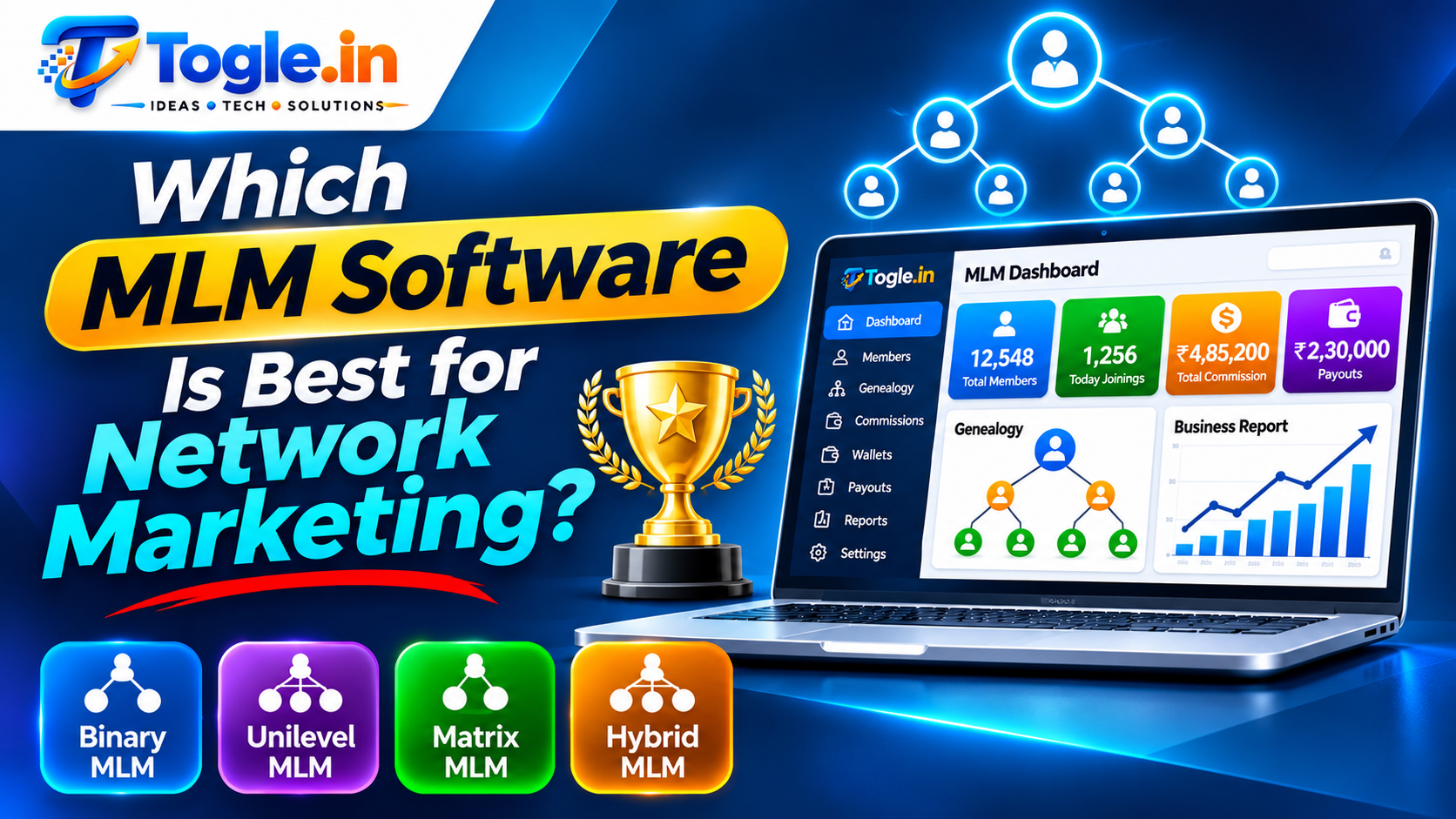
A. Binary MLM Plan
<image-placeholder></image-placeholder>
A Binary MLM plan places each distributor into two primary legs, commonly called the Left Leg and Right Leg.
Commissions may be calculated using eligible sales volume or business volume generated by the two legs.
Common features:
-
Two-leg genealogy structure.
-
Left and right team tracking.
-
Matching or pairing calculations.
-
Carry-forward volume, where permitted by the plan.
-
Commission caps and eligibility conditions.
A binary plan requires accurate volume tracking and clearly documented commission rules.
B. Unilevel MLM Plan
In a Unilevel MLM plan, a distributor can directly sponsor multiple distributors on the first level.
The company can define commission eligibility across multiple levels, subject to the compensation plan.
Common features:
-
Unlimited width at the first level.
-
Multiple commission levels.
-
Direct referral tracking.
-
Level-based commission calculations.
-
Distributor performance reports.
C. Matrix MLM Plan
A Matrix MLM plan uses a fixed width and depth.
For example:
-
3 × 3 Matrix: Three positions wide and three levels deep.
-
4 × 4 Matrix: Four positions wide and four levels deep.
-
5 × 5 Matrix: Five positions wide and five levels deep.
The software manages placement and genealogy according to the company's rules.
D. Forced Matrix MLM Plan
A Forced Matrix plan follows a predefined placement structure. When a distributor's immediate positions are filled, additional distributors may be placed according to the company's placement rules.
The software must maintain accurate placement records and prevent unauthorized changes.
E. Generation MLM Plan
A Generation MLM plan calculates commissions based on defined generations or leadership groups.
It may include:
-
Generation-based commissions.
-
Leadership qualifications.
-
Group sales conditions.
-
Rank-based incentives.
-
Performance requirements.
F. Hybrid MLM Plan
A Hybrid MLM plan combines two or more compensation structures, such as Binary, Unilevel, Matrix, or Generation.
It provides flexibility but requires careful financial modeling and software development.
Which MLM plan should you choose?
Do not select a plan simply because it is popular. First evaluate your products, margins, customer demand, distributor responsibilities, and legal requirements. Model the maximum possible commission liability before implementing the plan.
5. Register Your Company and Understand Legal Requirements
Legal compliance is essential before launching an MLM business.
The applicable rules depend on the country where your company operates and where its distributors and customers are located.
Depending on your jurisdiction, you may need to consider:
-
Business registration and company formation.
-
Tax registration and reporting.
-
Direct-selling regulations.
-
Consumer protection requirements.
-
Product safety, labeling and licensing.
-
Distributor agreements and company policies.
-
Refund, cancellation and return policies.
-
Data protection and privacy requirements.
-
Advertising and income-claim restrictions.
-
Payment processing and financial regulations.
Important considerations for India
If you plan to operate in India, review the applicable Consumer Protection (Direct Selling) Rules, 2021, including subsequent amendments and relevant state requirements.
You should pay particular attention to:
-
Transparent product or service information.
-
Written agreements and distributor disclosures.
-
Customer grievance handling.
-
Refund and return policies.
-
Prohibition of pyramid schemes and money circulation schemes.
-
Compensation linked to genuine sales rather than recruitment fees.
Consult a qualified legal professional to review your business structure, compensation plan, products, agreements, and marketing claims before launch.
Important: Registering a company does not automatically make every MLM compensation plan lawful. The actual business operations and compensation structure matter.
6. Choose Professional MLM Software
Once your products, business model, and compensation plan are ready, you need reliable MLM software.
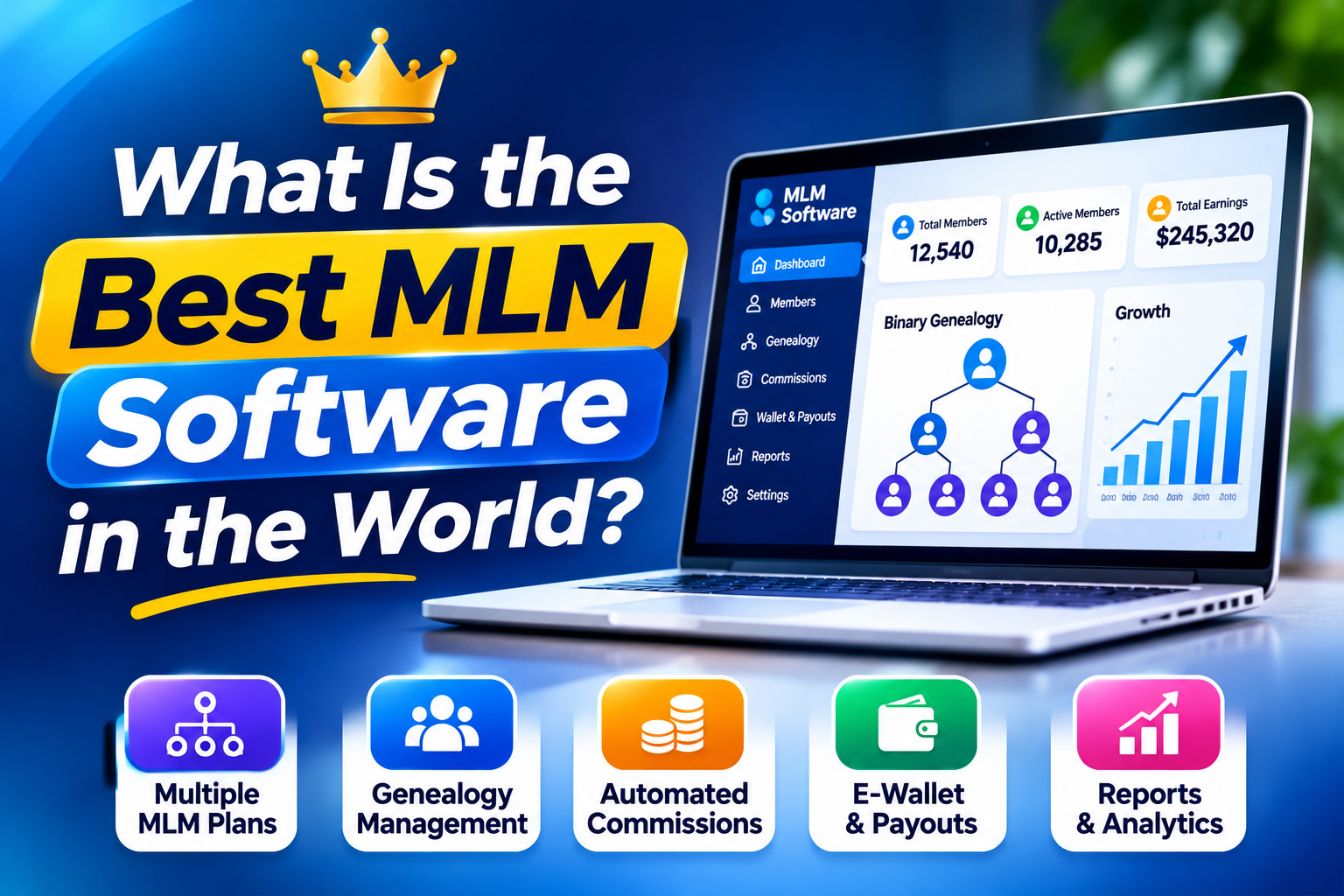
MLM software helps automate distributor registration, genealogy management, commission calculations, wallet transactions, sales tracking, and business reporting.
Managing these operations manually becomes difficult as your distributor network grows.
Essential MLM software features
1. Member Registration
-
Distributor registration.
-
Referral link generation.
-
Sponsor tracking.
-
Unique member IDs.
-
Account activation.
2. Genealogy Management
-
Binary genealogy.
-
Unilevel genealogy.
-
Matrix genealogy.
-
Sponsor tree.
-
Placement management.
-
Downline reports.
3. Commission Management
-
Direct referral commissions.
-
Matching commissions.
-
Level commissions.
-
Generation commissions.
-
Rank and achievement incentives.
-
Commission capping and eligibility rules.
4. Wallet Management
-
Commission wallet.
-
Deposit wallet.
-
Withdrawal wallet.
-
Fund transfer.
-
Transaction history.
-
Wallet statements.
5. E-commerce and Product Management
-
Product catalog.
-
Shopping cart and checkout.
-
Order management.
-
Purchase history.
-
Repurchase management.
-
Inventory tracking.
6. Payment Gateway Integration
-
Online payment processing.
-
Payment status verification.
-
Transaction tracking.
-
Refund management.
-
Payout integration, where supported.
7. Admin Dashboard
-
Total members.
-
Sales reports.
-
Commission reports.
-
Withdrawal requests.
-
Product management.
-
Member management.
-
Business analytics.
8. Security Features
-
Secure authentication.
-
Role-based permissions.
-
Data encryption where appropriate.
-
Activity logs.
-
Secure payment verification.
-
Backup and recovery.
Why custom MLM software can be useful
Every MLM company has different business requirements. A company operating a Binary plan may need different commission calculations from a company using a Unilevel or Hybrid plan.
Custom MLM software can help you implement your documented compensation rules, integrate your payment systems, manage your products, and support your operational workflow.
At Togle.in, you can explore MLM software development solutions for different network marketing business models.
7. Estimate Your MLM Software Development Budget
Your software investment depends on the compensation plan, required features, integrations, security, and customization.
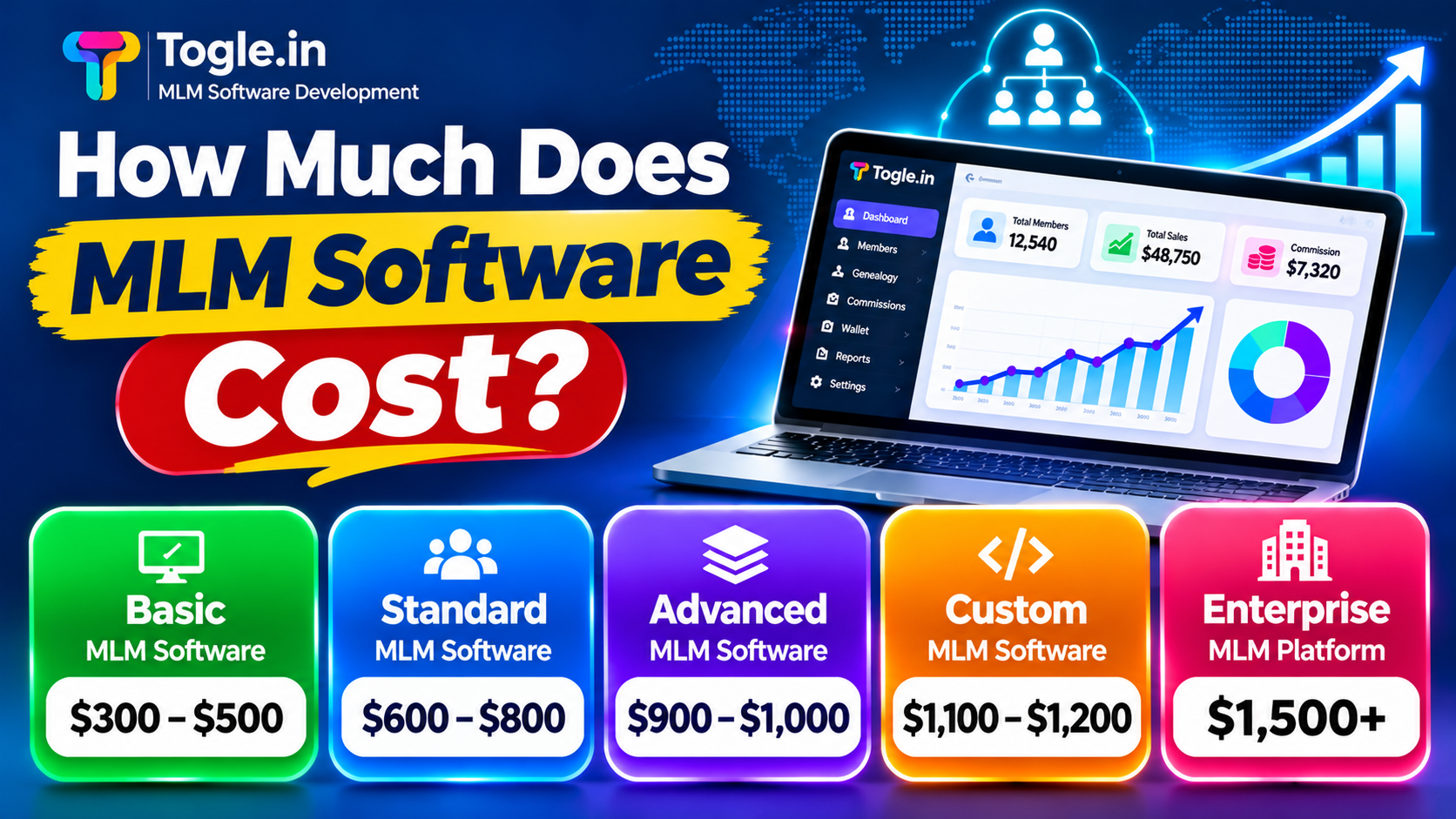
Here is an indicative development pricing structure:
| MLM Software Package | Estimated Price |
|---|---|
| Basic MLM Software | $300 – $500 |
| Standard MLM Software | $600 – $800 |
| Advanced MLM Software | $900 – $1,000 |
| Custom MLM Software | $1,100 – $1,200 |
| Enterprise MLM Platform | $1,500+ |
What affects the development cost?
-
Number of compensation plans.
-
Complexity of commission calculations.
-
Genealogy and placement requirements.
-
E-commerce and inventory integration.
-
Payment gateway and payout integration.
-
Mobile application requirements.
-
Security and reporting requirements.
-
Custom design and third-party integrations.
These are indicative starting estimates, not fixed quotations. The final cost depends on the exact scope, technical requirements, integrations, and project agreement.
Also budget separately for hosting, domain registration, payment gateway charges, maintenance, security updates, and third-party services where applicable.
8. Build Your Website and Company Brand
Your website is the digital identity of your MLM company.
It should explain your products, services, business policies, and distributor opportunities clearly.
Important website pages
-
Home
-
About Us
-
Products or Services
-
How It Works
-
Compensation Plan
-
Business Opportunity
-
Distributor Registration
-
Login
-
Frequently Asked Questions
-
Contact Us
-
Privacy Policy
-
Terms and Conditions
-
Refund and Return Policy
-
Distributor Agreement
Your website should be mobile-friendly, fast-loading, secure, and easy to navigate.
Use clear product descriptions and avoid misleading income claims or exaggerated business opportunity advertisements.
9. Set Up Distributor Registration and Onboarding
After your website and MLM software are ready, configure the distributor registration process.
A good onboarding system makes it easier for new distributors to understand the business and begin operating responsibly.
Recommended registration process
-
Visitor opens your registration page.
-
Visitor enters the sponsor or referral ID, if applicable.
-
Visitor submits the required information.
-
The system validates the registration details.
-
The distributor accepts the applicable agreement and policies.
-
The account is created.
-
The distributor receives login credentials or account activation instructions.
-
The distributor accesses the dashboard and training resources.
Collect only the personal information necessary for legitimate business operations and handle it according to applicable privacy laws.
Avoid making product purchases or recruitment payments a condition for earning compensation unless the arrangement is lawful and properly structured in your jurisdiction.
10. Build a Strong Distributor Training System
A successful network marketing company needs trained distributors.
Simply registering people does not create a sustainable business. Distributors need to understand your products, customers, company policies, and sales process.
Training topics to include
-
Product knowledge.
-
Product demonstrations.
-
Customer communication.
-
Ethical selling practices.
-
Customer service.
-
Company policies.
-
Compensation plan explanation.
-
Referral and marketing guidelines.
-
Social media marketing.
-
Order and delivery procedures.
Create training videos, downloadable guides, presentations, and frequently asked questions.
Focus on helping distributors find genuine customers and provide good service.
11. Develop an Effective MLM Marketing Strategy
Marketing helps people discover your company and products.
A combination of digital marketing, customer referrals, educational content, and offline promotion can help you reach your target audience.
A. Search Engine Optimization (SEO)
Publish useful articles related to your products, industry, and customer needs.
Examples:
-
What Is MLM?
-
How Does Network Marketing Work?
-
How to Start an MLM Business?
-
Different Types of MLM Compensation Plans.
-
How to Choose MLM Software?
-
Benefits of Direct Selling.
Use relevant keywords naturally, write informative content, and build a technically sound website.
B. Social Media Marketing
Use platforms such as:
-
Facebook.
-
Instagram.
-
YouTube.
-
LinkedIn.
-
Other relevant regional platforms.
Publish product information, tutorials, customer support information, educational videos, and company updates.
Avoid misleading income screenshots or guaranteed earning promises.
C. Content Marketing
Create valuable content that answers real questions.
Examples include:
-
Product usage guides.
-
Customer education videos.
-
Product comparison articles.
-
Business model explanations.
-
Distributor training resources.
D. Email Marketing
Use email to send:
-
Product announcements.
-
Training materials.
-
Order updates.
-
Company newsletters.
-
Policy updates.
Obtain appropriate consent and provide unsubscribe options where required.
E. Customer Referral Marketing
Encourage satisfied customers to recommend your products. Any referral rewards should be transparent, properly documented, and compliant with applicable laws.
12. Manage Orders, Inventory and Customer Support
Your MLM business should operate like a professional product or service company.
You need reliable processes for:
-
Product availability.
-
Order confirmation.
-
Payment verification.
-
Shipping and delivery.
-
Returns and refunds.
-
Customer complaints.
-
Distributor support.
-
Sales and inventory reports.
Keep customer service separate from recruitment activities. Customers should receive proper assistance whether or not they join your distributor network.
13. Test Your MLM Software Before Launch
Never launch your MLM platform without proper testing.
Commission calculation errors, incorrect genealogy placement, duplicate transactions, and payment problems can damage your business reputation.
Essential testing checklist
-
Registration and login.
-
Referral and sponsor tracking.
-
Genealogy placement.
-
Commission calculations.
-
Commission eligibility and capping.
-
Product orders and sales.
-
Payment gateway verification.
-
Wallet credit and debit.
-
Withdrawal requests.
-
Admin approval processes.
-
Reports and transaction history.
-
Security and access permissions.
-
Mobile responsiveness.
-
Backup and recovery.
Test your compensation plan with different scenarios before processing real commissions.
Maintain transaction records and ensure that commission calculations can be audited.
14. Launch Your MLM Business Step by Step
Once your products, policies, website, software, and operations are ready, you can begin your launch.
A practical launch sequence is:
Phase 1: Preparation
-
Finalize products and pricing.
-
Complete business registration and compliance review.
-
Prepare the compensation plan.
-
Calculate the financial model.
Phase 2: Development
-
Develop the company website.
-
Configure MLM software.
-
Integrate payment systems.
-
Configure products and distributor registration.
Phase 3: Testing
-
Test registration and genealogy.
-
Verify commission calculations.
-
Test payments and withdrawals.
-
Review policies and customer support procedures.
Phase 4: Launch
-
Publish the website.
-
Introduce products to potential customers.
-
Train initial distributors.
-
Start ethical marketing campaigns.
Phase 5: Growth
-
Monitor customer satisfaction.
-
Analyze product sales.
-
Review commission expenses.
-
Improve distributor training.
-
Expand only when operations can support growth.
15. Common Mistakes to Avoid When Starting an MLM Business
Many new MLM businesses struggle because they focus on recruitment and expansion before building a reliable product and operational foundation.
Avoid these common mistakes:
1. Launching without genuine products
A sustainable direct-selling company needs products or services that customers actually want.
2. Choosing an unclear compensation plan
Distributors should understand how commissions are earned, calculated, qualified, and paid.
3. Ignoring legal requirements
Review applicable direct-selling, consumer protection, advertising, tax, and product regulations before launch.
4. Using unreliable MLM software
Incorrect calculations or insecure wallet transactions can create serious operational problems.
5. Promising guaranteed income
Never guarantee earnings or advertise unrealistic income expectations. Actual results vary and depend on many factors.
6. Ignoring customer satisfaction
Product quality, delivery, refunds, and customer service are essential to long-term business sustainability.
7. Expanding too quickly
Build reliable operations and financial controls before entering new markets.
8. Failing to monitor commission expenses
Model your commission liabilities against actual product revenue and operating costs.
16. How Much Investment Is Required to Start an MLM Business?
There is no single investment amount that applies to every MLM company.
Your budget depends on the products, business location, company structure, legal requirements, website, software, inventory, marketing, and operational team.
Consider these cost categories:
| Expense | What it covers |
|---|---|
| Business setup | Registration and professional services |
| Product development | Sourcing, manufacturing and testing |
| Branding | Logo, packaging and marketing materials |
| Website | Company website and online store |
| MLM software | Registration, genealogy and commissions |
| Hosting | Server, domain and infrastructure |
| Payment integration | Gateway and transaction charges |
| Marketing | Advertising and content creation |
| Operations | Staff, customer support and logistics |
| Compliance | Legal review, licenses and required documentation |
Prepare a detailed budget before investing. Keep sufficient working capital for product supply, refunds, customer support, and operating expenses.
17. How to Choose the Right MLM Software Development Company
Choosing the right technology partner can make a significant difference to your company's operations.
Before selecting a development company, evaluate:
-
Experience with MLM software development.
-
Knowledge of Binary, Unilevel, Matrix and Hybrid plans.
-
Ability to implement custom commission rules.
-
Experience with wallet and payment integrations.
-
Security and data protection practices.
-
Testing and quality assurance processes.
-
Technical support and maintenance.
-
Clear project scope and pricing.
-
Ownership and access to project deliverables.
Ask for a demonstration and test important features before making a final decision.
Why Choose Togle.in for MLM Software Development?
Togle.in focuses on MLM software development and network marketing technology solutions.
Whether you are planning to launch a Binary MLM company, Unilevel business, Matrix platform, or a customized network marketing system, choosing software that matches your actual business requirements is important.
Explore solutions that can support:
-
Member registration and management.
-
Referral and genealogy tracking.
-
Commission calculation.
-
Wallet and transaction management.
-
Product and order management.
-
Admin dashboards and reports.
-
Payment gateway integration.
-
Custom business workflows.
Visit https://togle.in/ to explore MLM software development services and discuss your project requirements.
18. Frequently Asked Questions (FAQs)
Q1. How can I start an MLM business from scratch?
Start by researching your target market, selecting genuine products or services, preparing a business plan, reviewing legal requirements, designing a sustainable compensation plan, and selecting reliable MLM software. Then build your website, test your operations, train distributors, and launch your business.
Q2. Is starting an MLM business profitable?
An MLM business can generate revenue if it offers valuable products or services, attracts genuine customers, manages expenses effectively, and operates lawfully. Profitability is not guaranteed and depends on product demand, operating costs, customer retention, and business execution.
Q3. How much money do I need to start an MLM company?
The investment depends on your business model, product sourcing, registration requirements, software, website, marketing, and operating costs. Prepare a detailed budget before launching rather than relying on a single estimated amount.
Q4. Which MLM compensation plan is best?
There is no universally best compensation plan. Binary, Unilevel, Matrix, Generation, and Hybrid structures have different characteristics. Select one based on your products, sales model, financial calculations, distributor needs, and legal review.
Q5. Do I need MLM software to start an MLM business?
You may initially manage a very small operation manually, but a growing distributor network requires reliable software for registration, genealogy, sales, commission calculations, wallets, transactions, and reporting.
Q6. Can I start an MLM business online?
Yes. You can operate a direct-selling business using a company website, online product catalog, distributor registration, payment processing, customer support, and MLM management software, subject to applicable laws.
Q7. How long does it take to develop MLM software?
The development timeline depends on the compensation plan, features, integrations, testing requirements, and customization. A basic project may take less time than a complex enterprise platform. Request a project-specific timeline from your development team.
Q8. Can I create a custom MLM compensation plan?
Yes. A custom compensation plan can be designed around your business requirements. However, it should be financially sustainable, transparent, properly documented, and reviewed for legal compliance before implementation.
Q9. What is the difference between MLM and a pyramid scheme?
A legitimate direct-selling business focuses on genuine products or services and real customer demand. A pyramid scheme generally relies on recruitment or participant payments rather than genuine retail sales. The legal distinction depends on the actual business structure and applicable law, not simply the label used by the company.
Q10. Can I start an MLM company internationally?
International operations may be possible, but each target country can have different company registration, direct-selling, consumer protection, product, tax, privacy, and payment requirements. Obtain local legal and tax advice before entering a new market.
Conclusion: Build Your MLM Business on a Strong Foundation
Starting an MLM business requires careful planning, genuine products, transparent compensation rules, legal compliance, reliable technology, and a customer-focused approach.
Do not rush into recruitment before establishing your business foundation. First validate your products and market demand, calculate your compensation structure, prepare your policies, and build reliable operational systems.
Professional MLM software can help automate distributor management, genealogy, commission calculations, payments, and reporting as your business grows.
If you are planning to launch a new network marketing company or upgrade an existing system, explore the MLM software development solutions available at Togle.in.
Build your business with a clear plan, genuine customer value, and reliable technology.
Disclaimer: This article is for general educational and informational purposes only. It is not legal, financial, or business advice. MLM and direct-selling laws differ by jurisdiction. Always obtain appropriate professional advice and ensure your business model complies with applicable laws before launching.
Like & Comments
Found this article helpful? Share your thoughts with us.
Leave a comment